
The stadium is becoming an address
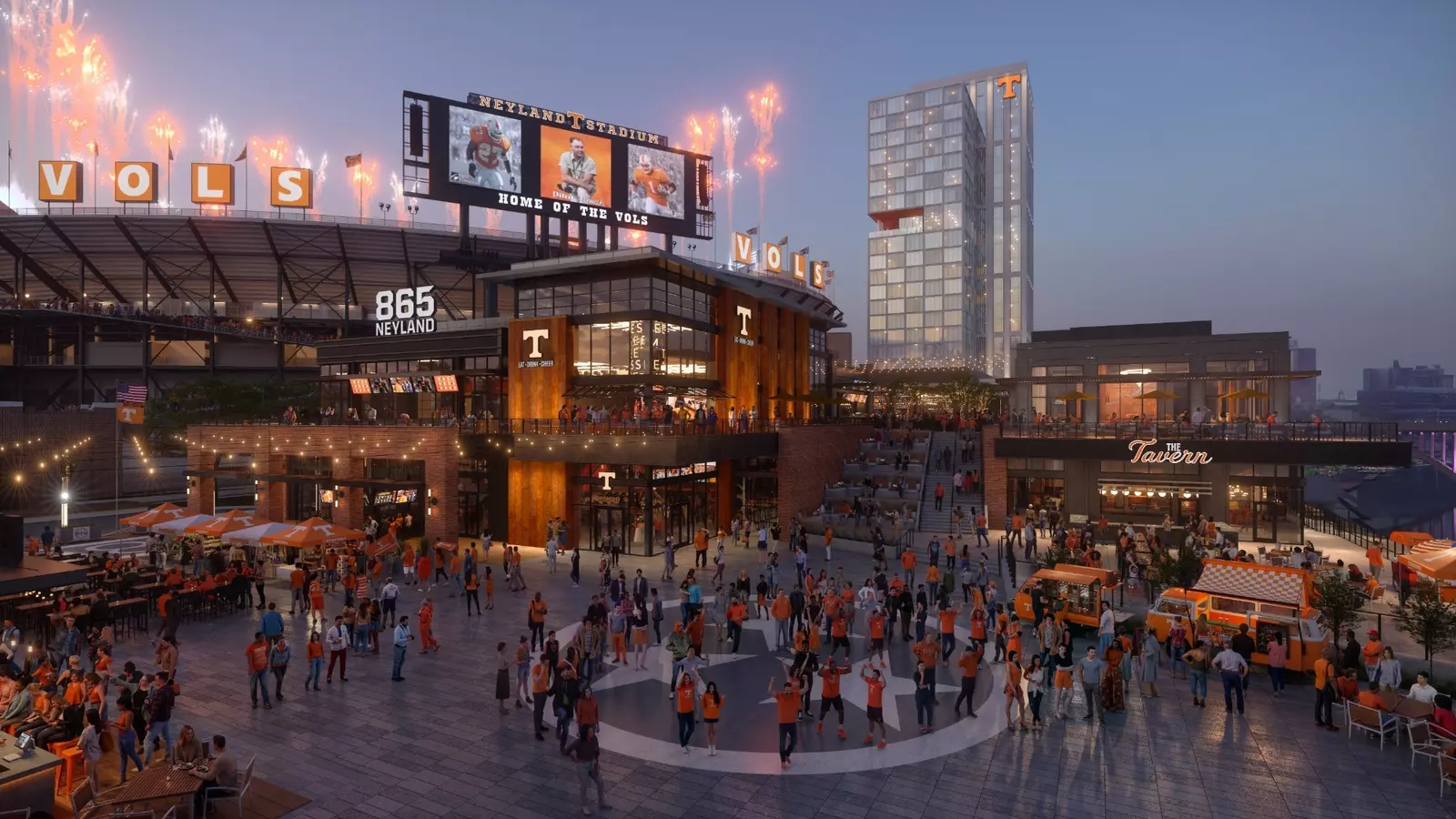
Tennessee football already has Neyland Stadium. What broke ground September 19 is a different type of athletics asset: approximately 100,000 square feet of indoor and outdoor entertainment, dining and retail space beside a 24-story hotel and residential tower.
The development sits between Neyland Stadium and Thompson-Boling Arena at Food City Center. UT says the name, 865 Neyland, will also become the project's future address. That is a useful clue to the strategy. College athletics is no longer treating the stadium edge as leftover circulation and parking. It is turning that edge into a destination with its own identity.
The parking garage is part of the development story
The physical sequence matters. UT says demolition of the G10 parking garage inside the development footprint is scheduled for fall 2026. A replacement garage is expected by August 2027. The entertainment district is scheduled for early 2028, followed by the condo-hotel tower in 2029.
PropertyLabs treats those as separate milestones. A groundbreaking is evidence that construction has begun on the project, not evidence that every component has started or that future demolition and completion dates have already occurred.
A football recruiting pitch is becoming real estate
UT athletic director Danny White explicitly connected the project to recruiting, saying the physical development gives Tennessee another way to demonstrate the scale of its fan base and facilities to student-athletes.
That makes 865 Neyland a crossover story in the literal sense. The competitive product is football, but part of the recruiting and fan proposition is now a mixed-use real-estate environment: rooftop hospitality, restaurants, sports bars, plazas, a performance stage, more than 3,000 square feet of LED displays and a 50-foot event screen.
The building program also stretches the economics beyond game day. UT says the district is designed for year-round use and projects more than 2.5 million annual visitors. That visitor figure is a project forecast, not measured operating performance.
The PropertyLabs question: what permits does a stadium district actually create?
A project like this should not be reduced to one construction record. The physical program can generate demolition, garage, tower, restaurant, tenant-improvement, signage, electrical, mechanical and public-realm records at different points in the build.
Knoxville's current development-services system organizes work around projects and associated permits. PropertyLabs has not identified a complete public permit stack for 865 Neyland from the sources reviewed for this article, so we are not assigning permit numbers or claiming individual permit issuances that we cannot verify. The concrete research question is now straightforward: as G10 comes down and vertical construction progresses, how does the public record decompose this one branded development into actual construction scopes?
Why this is bigger than Knoxville
The interesting model is the stadium edge becoming developable inventory. Professional teams have increasingly paired venues with mixed-use districts. Tennessee is applying a similar physical strategy to college athletics, but with a campus, donor, recruiting and game-day ecosystem layered on top.
That makes the next generation of college-sports facilities a land-use story as much as a seating-capacity story. The question is no longer only what gets renovated inside the stadium. It is what universities and their private partners can build around it.
Methodology and caveats
PropertyLabs reviewed UT Knoxville's September 21 groundbreaking release, Tennessee Athletics' September 16 project announcement and the City of Knoxville's development-services materials. Project size, jobs, visitors and economic-impact figures are attributed to UT and the development team and should be read as announced or projected figures rather than independently measured outcomes.
We distinguish the September groundbreaking from future garage demolition, component construction and completion milestones. We also distinguish a branded project announcement from an individually verified municipal permit record.