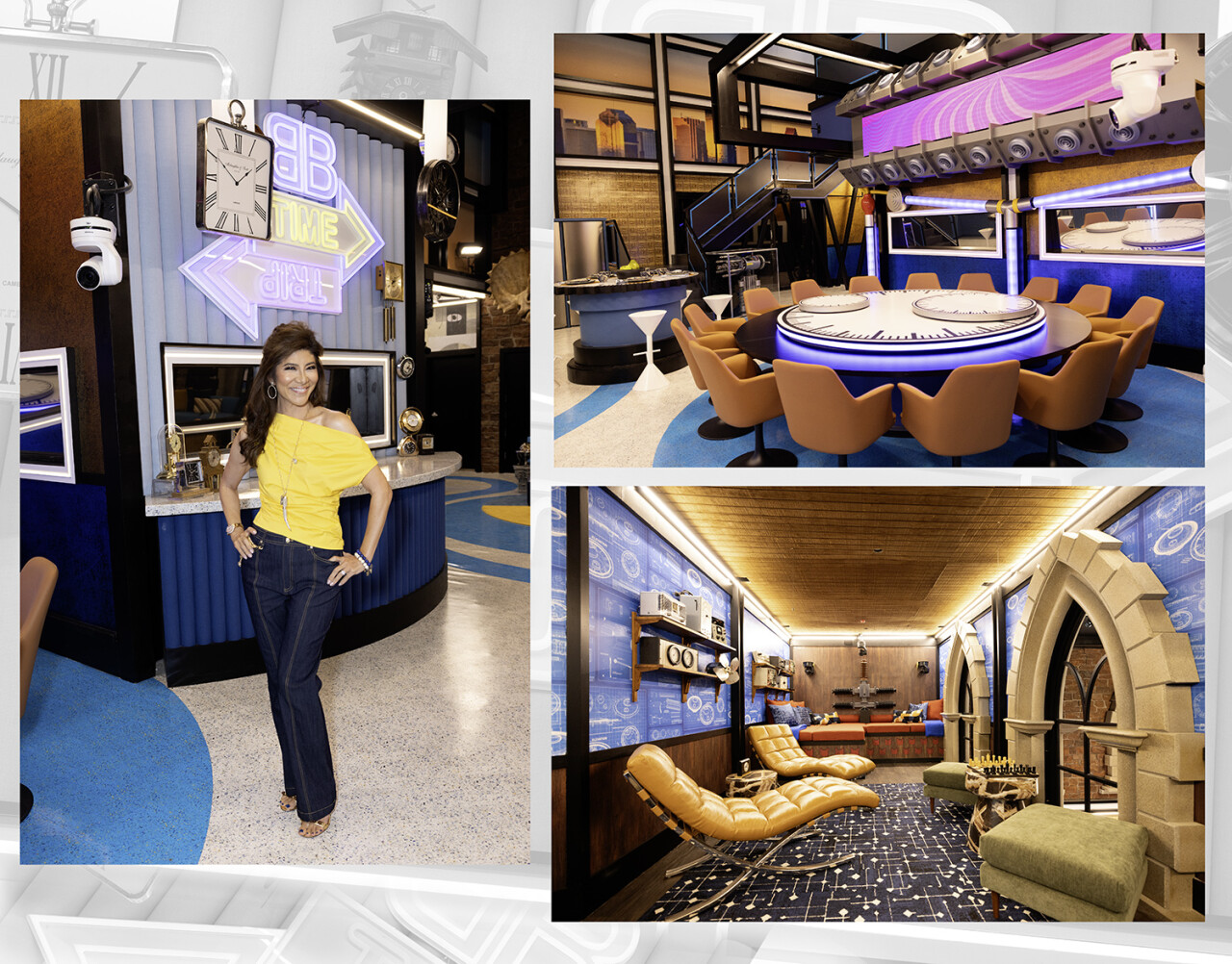
A house is usually designed around the people inside it. This one is designed around the people watching.
CBS describes Big Brother as a group of people living together while cameras and microphones record their every move around the clock. For Season 28, the network’s consumer site currently lists 112 HD cameras and 113 microphones. Paramount’s Season 28 press materials list 94 cameras and the same 113 microphones. That discrepancy is worth stating rather than smoothing over: the official sources do not currently agree on the camera count.
Either number makes the underlying point. This is not conventional residential space with cameras added afterward. Observation is one of the building’s core operating requirements.
That changes how space has to work. A normal house can tolerate dead angles, private corners and circulation that is visually uninteresting. A television environment built around continuous coverage cannot. Rooms have to support sightlines, lighting, audio capture, production access and a constantly changing cast while still reading on screen as somewhere people live.

The Big Brother house has two floor plans
There is the floor plan contestants experience: bedrooms, kitchen, bathroom, communal areas, Diary Room and outdoor space. Then there is the invisible operational plan: cameras, microphones, lighting, control infrastructure, production circulation and the spaces needed to operate the show without collapsing the illusion of a self-contained house.
Commercial real estate already understands this idea. A restaurant has a dining room and a back of house. A hotel has guestrooms and service corridors. A data centre has a visible building envelope and an enormous technological function that cannot be understood from the facade.
Big Brother applies the same principle to something deliberately styled as domestic space. The building has a human layer and a data layer.
That makes it an extreme version of a much broader real-estate trend
The interesting connection is not that ordinary homes are becoming Big Brother. They are not. It is that an increasing number of properties now have a digital or media function layered over their physical one.
Creator houses. A property can be selected as much for backgrounds, natural light, acoustics and filming angles as bedrooms or location.
Short-term rentals. Some properties are marketed partly on their ability to produce photographs and video that travel well on social platforms.
Production properties. Residential-looking locations can operate as sets, branded environments or recurring content infrastructure.
Smart apartments. Access control, environmental sensors, connected appliances and building systems increasingly create a second operational layer inside conventional residential space.
Branded and experiential real estate. The physical environment itself becomes part of a media product, customer experience or distribution strategy.
Those uses are different from one another, but they share something: square footage alone does not explain the economic function of the space.
What would the Big Brother house look like in a permit database?
This is where the thought experiment becomes useful for PropertyLabs.
A building-permit history can tell you a great deal about a property. Depending on the municipality, records can expose alterations, electrical work, mechanical work, additions, demolition, occupancy-related filings, declared construction value, applicants, contractors and dates. Follow the address over time and those records can reconstruct part of the physical history of a building.
But the permit tape does not necessarily tell you what the finished space has become operationally. It may capture the electrical work that supports a production environment without telling you that dozens of cameras will eventually use that infrastructure. It may capture an interior alteration without describing the economics of the content produced inside it.
That is an important limitation, not a weakness to hide. Administrative data describe administrative events. Understanding a property often requires connecting those events to other evidence.
A permit is a physical clue, not a complete biography
PropertyLabs’ research repeatedly comes back to this distinction. Our Permit Frontier study normalized 4.37 million municipal records across 24 U.S. city series and found that even basic comparisons require context because cities classify, publish and update records differently.
At the individual-building level, interpretation matters even more. A permit can establish that work was authorized. It does not automatically establish how the property is monetized, how intensely it is used or what happens there after construction.
The Big Brother house makes that abstraction obvious because its use is so unusual. Two spaces can look broadly residential in a database while having radically different operational lives.
The house is also a machine for studying how people actually use space
Architecture is normally evaluated with incomplete behavioral evidence. Designers can observe circulation, interview residents or study building performance, but they rarely get continuous footage of occupants using almost every shared space for weeks.
Big Brother reverses that. The program depends on observing where people congregate, where conversations happen, which spaces create privacy and which force interaction. The design is not a neutral container for the show. It helps create the social conditions the show records.
That does not mean Big Brother is a valid experiment in ordinary residential behavior. Contestants know they are being filmed, the environment is artificial and the incentives are extraordinary. But as an example of architecture deliberately shaping interaction, it is hard to miss.
The future “content property” may be designed differently from day one
For most residential real estate, cameras and content remain secondary. But there is a niche in which media performance is already part of the underwriting logic. A creator buying a house may care about ceiling height because of lighting. A production company may care about sound separation. A short-term-rental operator may spend more on visually distinctive common areas because those rooms sell the listing online.
The Big Brother house takes that logic to its extreme endpoint. The property is valuable because it supports the production of attention.
That is why calling it simply a house misses the interesting part.
The Big Brother house looks residential. Economically and operationally, it behaves more like media infrastructure.
Frequently asked questions
How many cameras are in the Big Brother house?
CBS currently lists 112 HD cameras and 113 microphones. Paramount’s Season 28 press materials list 94 HD cameras and 113 microphones, so the two official descriptions disagree on the camera count.
Why is the Big Brother house interesting from a real-estate perspective?
It demonstrates how a residential-looking environment can have a second operational function. The space has to support habitation and continuous television production at the same time.
Can permit data reveal a building’s real use?
Permit data can reveal physical and administrative changes, but it often needs to be combined with other sources to understand how a finished property actually operates.
Sources and methodology
Current show and equipment descriptions use CBS and Paramount’s official Big Brother materials. Because the two official sources publish different camera counts, both are disclosed rather than selecting one as definitive. PropertyLabs discussion of permits describes general administrative-data limitations and does not claim access to private permit or production records for the Big Brother set.
- CBS: Big Brother: About the show
- CBS: Big Brother Season 28
- Paramount Press Express: Big Brother 28 press materials and photos
- Paramount Press Express: Big Brother 28 photo archive
- CBS Mornings: Julie Chen Moonves gives a look inside the Season 28 house
- PropertyLabs Research: How to Check Building Permits by Address
- PropertyLabs Research: The Permit Frontier
Season 28 photography: CBS Broadcasting / Paramount Press Express official photo archive.