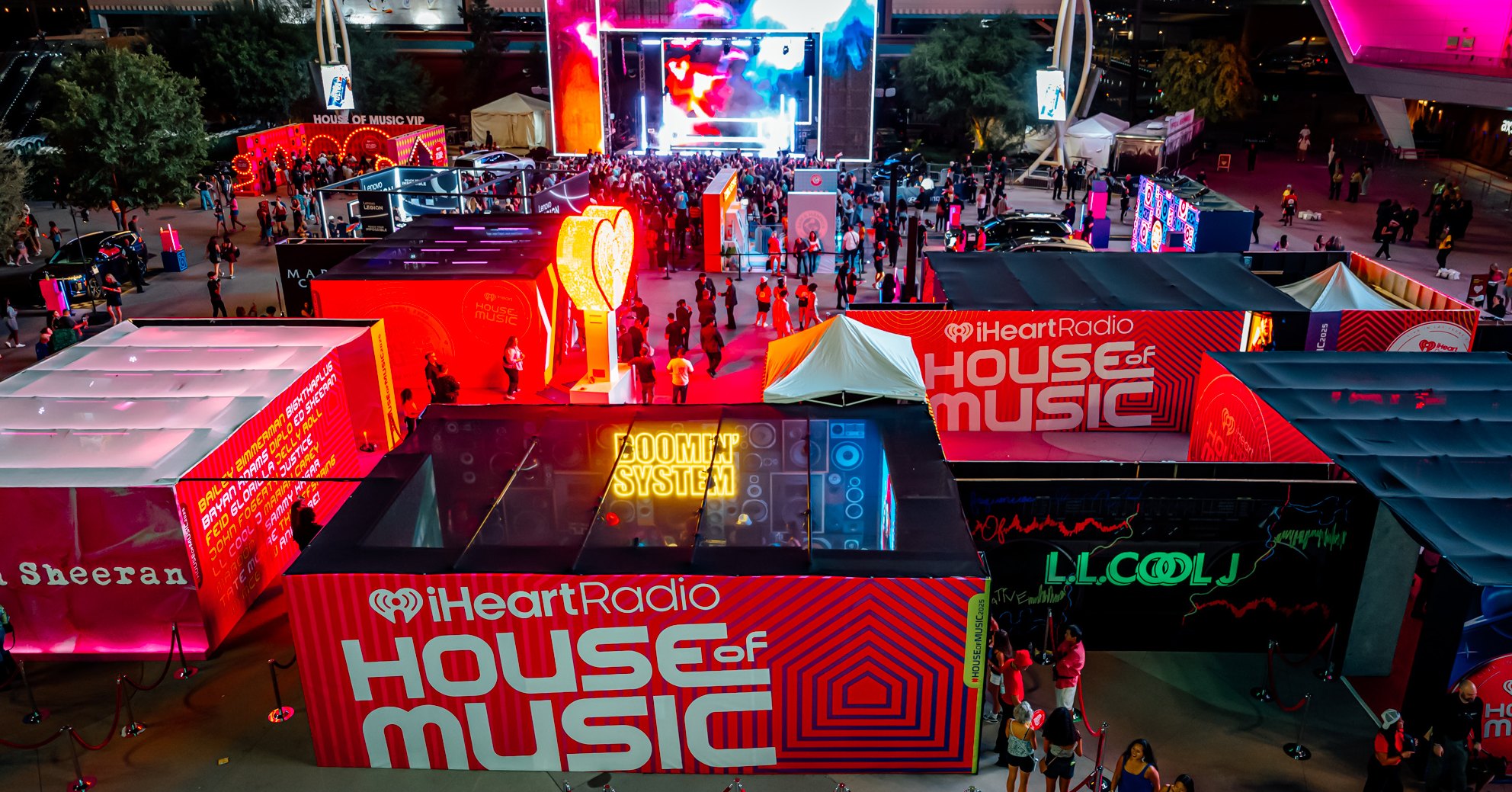
It has rooms. It has a house name. Nobody lives there.
The iHeartRadio House of Music Presented by Hyundai is open outside T-Mobile Arena in Las Vegas from 4 p.m. to 1 a.m. on September 18 and 19. It is free. Inside are artist-inspired rooms built around BTS, Cardi B, Kenny Chesney and Zara Larsson.
BTS gets an interactive pool inspired by “SWIM.” Cardi B gets a walk-through environment tied to her Little Miss Drama Tour. Kenny Chesney gets a lake-inspired Silver Sands Marina where visitors make postcards. Zara Larsson gets a Swedish-summer environment complete with a Girls Trip Gas Station.
Calling it a house is the joke. Functionally, it is temporary content infrastructure.
The occupants are also the distribution system
iHeartMedia's own advertising material is unusually explicit about what the physical environment is supposed to do. It describes photo opportunities, social sharing, experiential storytelling and interactive activations built around fan participation. In other words, the rooms are not simply scenery. They are prompts.
A normal room is successful when somebody wants to stay in it. A social-first room is successful when somebody reaches for a phone.
iHeart says the 2025 House of Music engaged more than 14,000 fans and generated more than 107 million social impressions. That is the economic logic of the building: a relatively small physical footprint can create an audience vastly larger than the number of people who ever enter it.

Big Brother captures you. House of Music gets you to capture yourself.
That distinction is why this is more interesting than another branded pop-up. In our analysis of the Big Brother 28 house, we described a residential-looking environment whose hidden operational plan is cameras, microphones, sightlines and production control. The occupant produces content because the building watches them.
House of Music reverses the camera. The building supplies the visual cue, but the visitor supplies the lens, the edit and the distribution. The BTS pool or Zara gas station does not need a broadcast camera pointed at every guest. The guest already arrived carrying one.
This is real estate designed for an algorithm
Retail has always cared about foot traffic. Experiential space adds a second traffic count: how far the physical visit travels after the visitor leaves. That changes what “productive” space can mean. A wall may have more value as a camera background than as shelving. A room can be optimized for a fifteen-second clip rather than an hour-long stay.
The physical building becomes an acquisition surface for a digital audience. That is not metaphorical when the operator itself measures the experience in social impressions.
Big Brother built rooms for cameras. House of Music builds rooms for camera phones. Same basic trick: make architecture part of the content machine.
What the permit record misses
This also exposes a limit of conventional property data. A permit, certificate or temporary-event approval can tell you something happened physically. It may describe electrical work, temporary structures, occupancy or alterations. It usually cannot tell you that the finished space was engineered to generate a BTS clip, a branded selfie or 107 million social impressions.
That is the same lesson we found in the Big Brother house: municipal records describe physical intervention better than economic intent. The filing is a clue. The use is the story.