
The merger story has a property clause
California Attorney General Rob Bonta announced a settlement Monday with Paramount Skydance resolving the states' antitrust challenge to its acquisition of Warner Bros. Discovery. The headline commitments are about film output, workers and competition: at least $1.5 billion of additional domestic film-production investment over five years, minimum theatrical-output requirements and a $47.5 million worker fund.
But the settlement terms also reach directly into real estate. Paramount agreed not to sell the Paramount Pictures or Warner Bros. studio lots in California for five years.
That is unusual enough to matter. A corporate merger agreement is effectively putting a hold period around two enormous physical production platforms at the same moment Hollywood is debating whether film and television work will stay in California.
A studio lot is industrial infrastructure for entertainment
The Paramount Pictures property at 5555 Melrose Avenue is not simply a headquarters with a famous gate. Paramount has disclosed approximately 62 acres and about 1.85 million square feet of floor area across sound stages, production facilities, offices, theatres, equipment facilities and related uses.
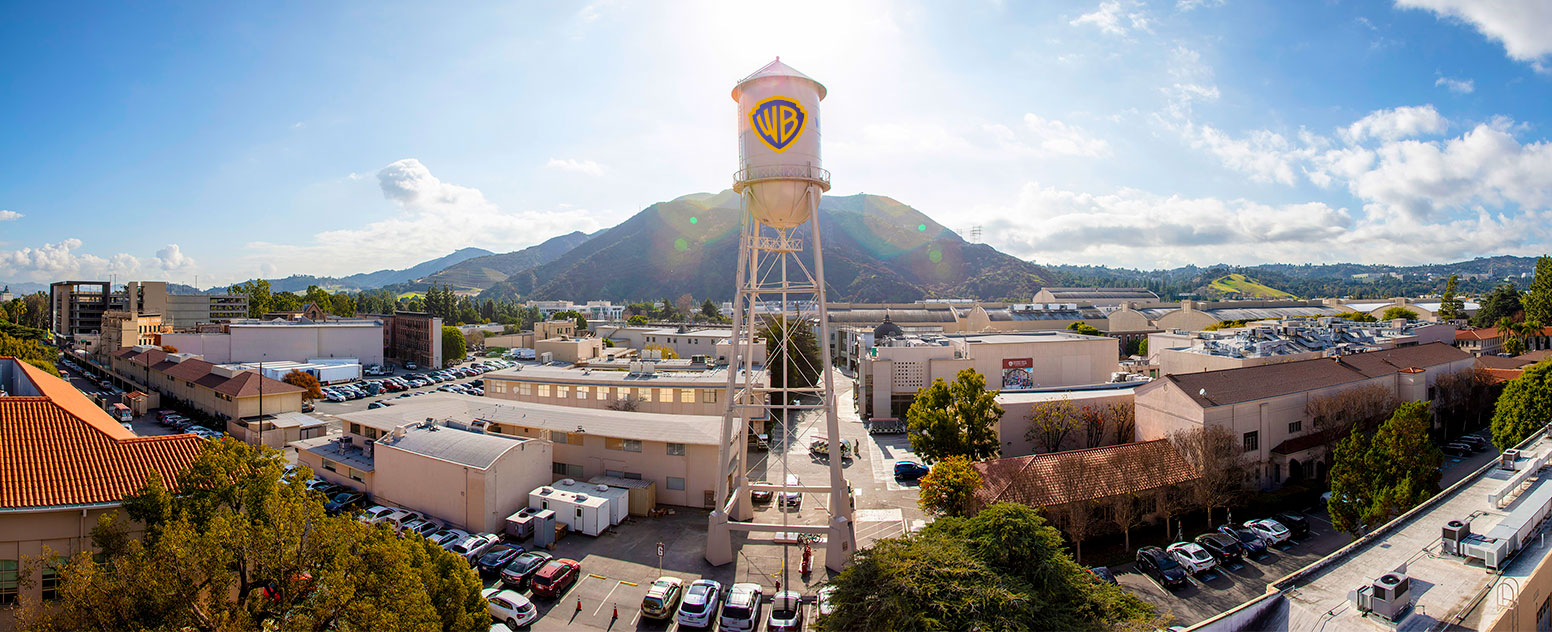
Warner Bros. operates its own large Burbank production campus with sound stages, exterior sets and production-support infrastructure. These properties function more like specialized industrial campuses than conventional offices. Their value comes partly from the dense network of stages, mill space, production services, backlots, power, technical infrastructure and nearby entertainment labor.
That makes a five-year no-sale commitment materially different from promising to keep a corporate mailing address in California.
The $1.5 billion commitment is not the same thing as $1.5 billion of construction
This distinction matters. The settlement's additional $300 million per year of U.S. film-production spending is a production commitment, not a real-estate capital budget. It can flow to labor, sets, equipment, locations, vendors and other production costs without producing a building permit.
Likewise, keeping the studio lots does not mean new sound stages have been approved or that construction has started. The settlement preserves major physical production assets while requiring more output. Whether that translates into renovations, stage upgrades, utility work or new construction is a separate question that should eventually leave its own permit trail.
This is the built-environment consequence of the Hollywood production fight
For years, states and countries have competed for film production through tax credits while Los Angeles has wrestled with production declines and underused studio capacity. The Paramount-Warner settlement turns part of that policy fight into a property constraint: the combined company cannot simply monetize these California lots through a near-term sale while satisfying its other commitments elsewhere.
The more useful PropertyLabs research question begins after the merger closes. Do the preserved lots generate a measurable increase in alteration, stage, electrical, mechanical or other building-permit activity as production commitments ramp? Or does the company satisfy the production requirement largely within the existing physical footprint?
What PropertyLabs would watch next
The first receipts are corporate rather than municipal: court approval of the settlement, merger closing and the production schedule. The physical receipts come later. Around Hollywood and Burbank, we would watch permits and applications tied to stage renovations, production-support buildings, power and mechanical upgrades, demolition and any new vertical construction.
A merger closing is not a construction start. A five-year no-sale clause is not an entitlement. And $1.5 billion of production spending is not $1.5 billion of development. Keeping those categories separate is exactly what makes the real-estate signal useful.
Methodology and caveats
PropertyLabs reviewed the California Attorney General's September 21 settlement announcement, Paramount regulatory disclosures, Paramount property disclosures and Warner Bros. Studio Operations materials. The five-year studio-lot restriction is a settlement commitment and remains subject to the settlement's legal terms and court process.
PropertyLabs does not infer construction from production spending, corporate ownership or a source-feed change. Any future claim about physical investment should be tied to an application, permit, contract, announced capital project or observed construction milestone.
Sources
- California Attorney General: September 21 settlement announcement and production commitments
- Paramount: Regulatory status of the Warner Bros. Discovery acquisition
- Paramount SEC filing: Paramount Pictures lot property disclosure: approximately 62 acres and 1.85 million square feet
- Warner Bros. Studio Operations: Official Burbank studio operations and photography
- Wikimedia Commons: Paramount Pictures Melrose Gate photograph by Coolcaesar, CC BY-SA 4.0
